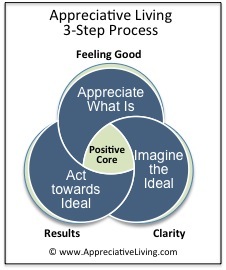
The AIA Process is a simple way to think about integrating the principles of Appreciaitive Inquiry (AI) in our personal lives. This section was excerpted from the book Appreciative Living: The Principles of Appreciative Inquiry in Personal Life by Jackie Kelm.

Appreciating
Finding what’s right with the present situation or person
Ask: Do I feel good about this person or situation?
Imagining
Creating inspiring images of the ideal future
Ask: Am I clear about what I want?
Acting
Taking small steps now to move forward
Ask: Do my thoughts and actions align with my wants?
The steps in the AIA process are: Appreciating the present, Imagining the ideal, and Acting now in alignment. The purpose of these steps is to help us feel good about the current situation or person, get clear about what we want, and take action that aligns with our ideal future. The AIA process keeps us on course by asking three things in our daily interactions and experiences:
The first step is appreciating the present. It suggests that we learn to see the good attributes, the available learning, and the positive possibilities of our present experience. Exercises include things like “Gratitude lists,” “Finding the Positive Core,” “Shifting Focus,” and “Reframing.” In this step we learn how to appreciate what we have right now.
The next step is imagining the ideal. On a grand scale, we create an image of what we want most, or what things would look like if they were exactly as we’d have them. We learn to create visions that are so provocative and meaningful, we feel excited and inspired in our everyday lives. On a smaller scale, we decide what we want in the moment. Imagining includes such exercises as “Gaining Clarity,” “Envisioning the Ideal,” and “Surfacing Assumptions.”
The last step is acting now in alignment. This means taking a small step forward to think or behave in ways that are consistent with our greatest future images. The change can (and should) be something small, and does not have to be a physical action. It can be a change in our focus, our questions, or our ways of perceiving. Exercises include “Enacting,” “Acknowledging the Good,” and “Developing Conversational Awareness.”
To download a copy of these pages, click here for the PDF file of the AIA Process. For more information on the AIA process, including the exercises mentioned above, examples, and underlying theory, please see the book Appreciative Living: The Principles of Appreciative Inquiry in Personal Life by Jackie Kelm.
Your Information Is Secure: We never, under any circumstances, share or sell any personal information entered here, and treat it as carefully and sensitively as our own. You may unsuscribe from our list at any time, and easy instructions on how to do this are always posted at the bottom of every email. The last thing we want to be is spam in your inbox! If you have any questions about our privacy policy or this series, email us at: List@AppreciativeLiving.com, or call (843) 881-1106
Sign me up for the FREE
Getting Started with
Appreciative Living mini-book
and monthly ezines on living a more joyful life!
If you have any questions, feel free to email me at JKelm@AppreciativeLiving.com or call me at (800)-214-0959 or (843) 881-1106 from outside the US
Contact Us: (800) 214-0959 or email Admin@AppreciativeLiving.com | Copyright 2010 J. Kelm