
What is the Appreciative Mindset? A Foundation for Joy, Wellbeing, and Lasting Change
The Appreciative Mindset is a thinking orientation directed toward positive aspects of reality that lead to greater joy, wellbeing, and success. It is the core thinking orientation of Appreciative Living created by Jackie Kelm.
Rather than focus on problems and difficulties, the Appreciative Mindset directs attention toward what’s right, working, wanted, and life-giving. The positive emotion generated from this way of thinking puts the brain in an ideal cognitive state for generating solutions, making decisions, and taking action. It also promotes physical health.
In short, while the Appreciative Mindset leads to greater joy, it’s also the key to creating better health and success or whatever you desire in life.
The Appreciative Mindset Reframes the Negative
The Appreciative Mindset does not ignore the negative, it appreciates the depth and wholeness it brings to life, and when appropriate, uses it as a catalyst for creating more joy. It is often misunderstood as ignoring problems or bypassing the negative side of reality. It works with the negative in the following three ways.
1. The Appreciative Mindset is about finding the good that legitimately exists in your perception of yourself and the world around you. It’s not about making it up or affirming what you want to see. It’s noticing a supportive loved one in difficult times, the kindness of a stranger when your car breaks down, or the coming together of people in crisis.
2. The Appreciative Mindset does not ignore pain and problems, it changes the way they are perceived and then experienced. It makes them less painful and easier to deal with. Emotions like grief and sorrow in particular are appreciated for the depth and wholeness they bring to life.
3. The tools of Appreciative Living, such as the Appreciative Living Rapid Change Process and Habit Breaker Technique, work directly with negative emotions, habits, and patterns. The Appreciative Mindset serves as the core thinking orientation for these tools, and bad habits and negative experiences are an integral part of the transformation they generate.
What We Focus on Grows: The Focus Principle of Appreciative Living
One of the five core Appreciative Living principles (adapted from Appreciative Inquiry), is the Focus Principle. The essential idea of this principle is that what we focus on expands, and our emotional experience follows our focus.
The brain has a natural negative bias that causes it to focus more on pain than pleasure as a survival mechanism. When we consistently focus on problems, threats, or what’s going wrong, our nervous system responds accordingly, and we begin to feel stressed, discouraged, or overwhelmed.
Conversely, when we direct our attention toward strengths, possibilities, and what is working, we feel good. This isn’t because reality has suddenly changed, it’s because our attention has. As we continue to focus in one direction over time, we build momentum that can move us far in one direction or another.
Intentionally looking for the positive aspects balances this negative bias and expands our perspective of reality. Your brain begins to notice good things it would have otherwise filtered out. Negative focus can spiral into anxiety and emotional distress, while positive focus can spiral into confidence, inspiration and joy.
By consciously choosing where we place our focus, we influence how we feel, how we think, and ultimately how we respond to life.
Good and Bad are Belief-Based Perspectives, Not Objective Truths
Appreciative Living rests on the philosophy of social construction, which suggests that each of us experiences life through a unique lens. Our perceptions are shaped by our personal history, cultural context, and the meaning we’ve learned to make with others over time.
What we label as good or bad is a belief, and not an objective truth. As we move through life we form many beliefs about what is right or wrong, good or bad, beautiful or ugly, valuable or worthless. These beliefs are shaped by experience and the influences of those around us. If you grew up in a home with positive interactions with dogs, you likely see them as friendly and lovable. If you were bitten as a young child, or your parents were afraid of dogs, you may perceive them as dangerous or threatening.
What each person believes to be positive or negative is unique and constantly evolving with each new experience. I might believe that all dogs are dangerous, but after spending a peaceful weekend caring for a friend’s tame dog, that belief may soften or change altogether.
A core belief of the Appreciative Mindset is that there are positive aspects in every person and situation, no matter how negative they appear. This does not mean ignoring danger, denying problems, or pretending everything is fine. It means recognizing that our negative judgments are partial views of reality, and there is another side to the story.
When we adopt an Appreciative Mindset, we begin to look for what else might be true and widen the positive lens. We become more open to seeing strengths within struggles, new beginnings with death, caring in crisis. This expanded positive perspective creates the emotional and cognitive capacity to experience more joy, success, and overall wellbeing.
The Appreciative Mindset Curtain Metaphor: How Focus Shapes Experience
We use a curtain metaphor in Appreciative Living to visually describe the Appreciative Mindset.
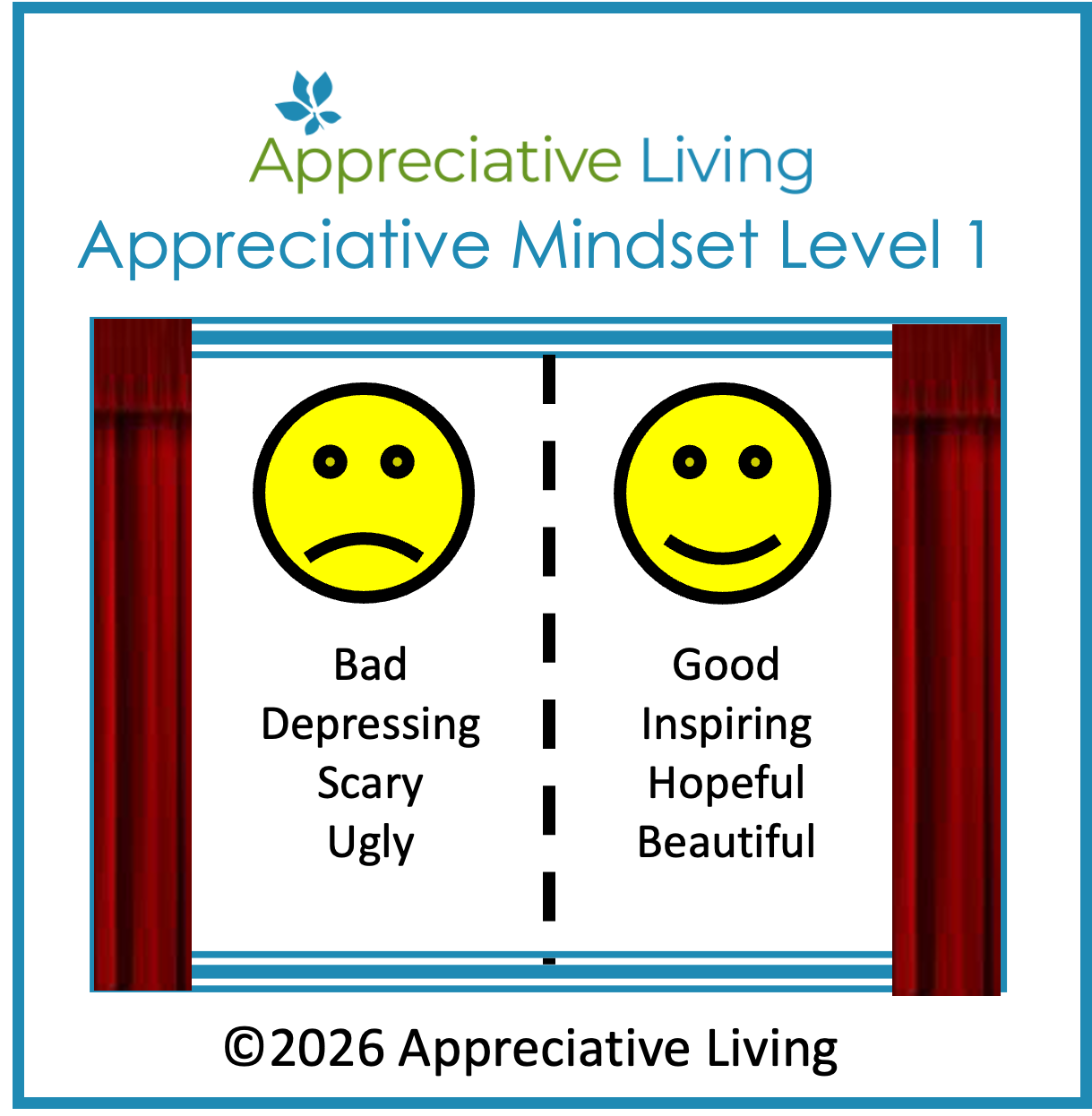
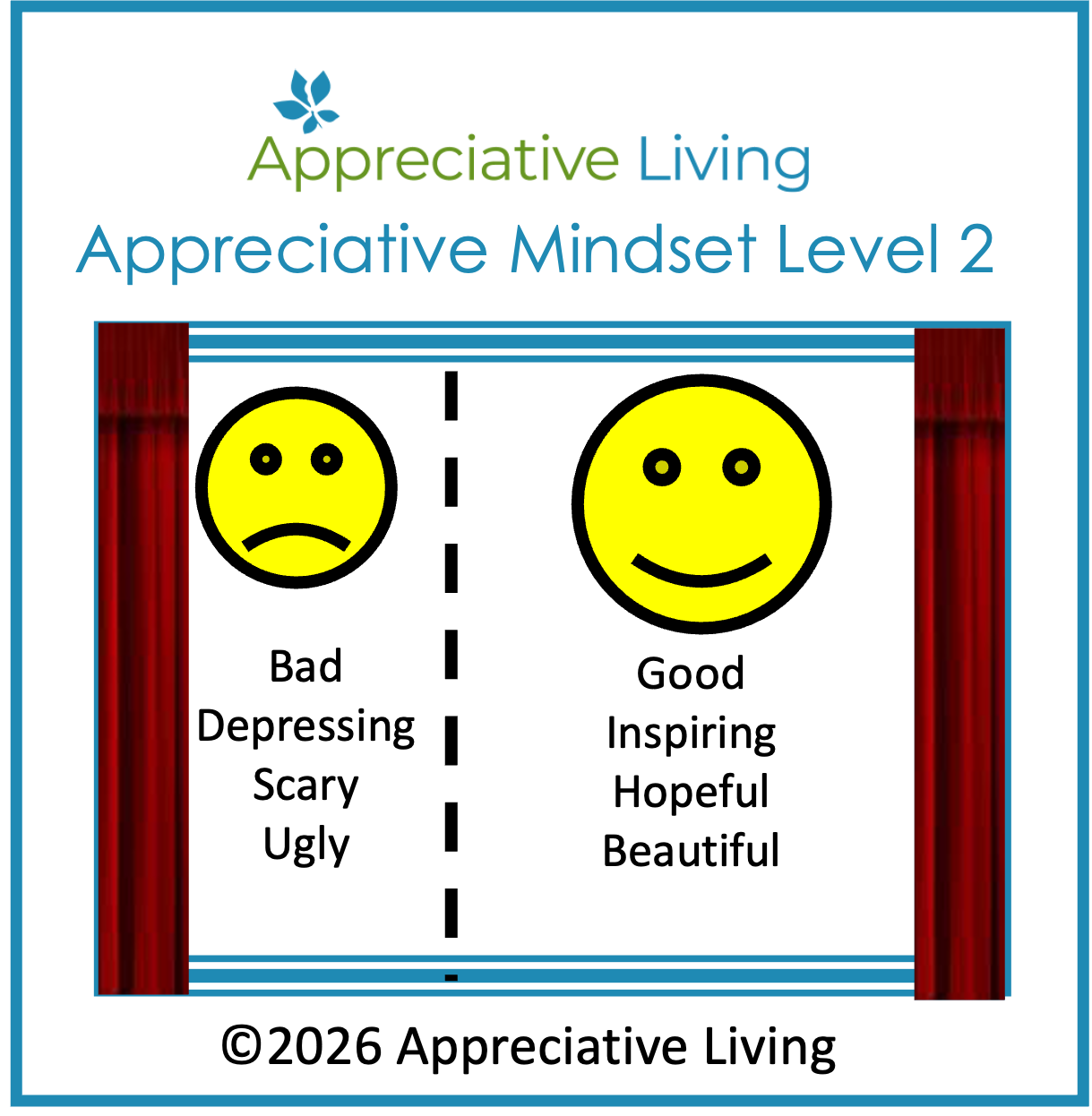
Think of your life as a movie playing on a screen in front of you with a line down the middle. One side contains all the things you perceive in this moment as good, and the other side contains what you perceive as bad. Every moment (including you and the people in it) has both positive and negative aspects. See the diagrams below.
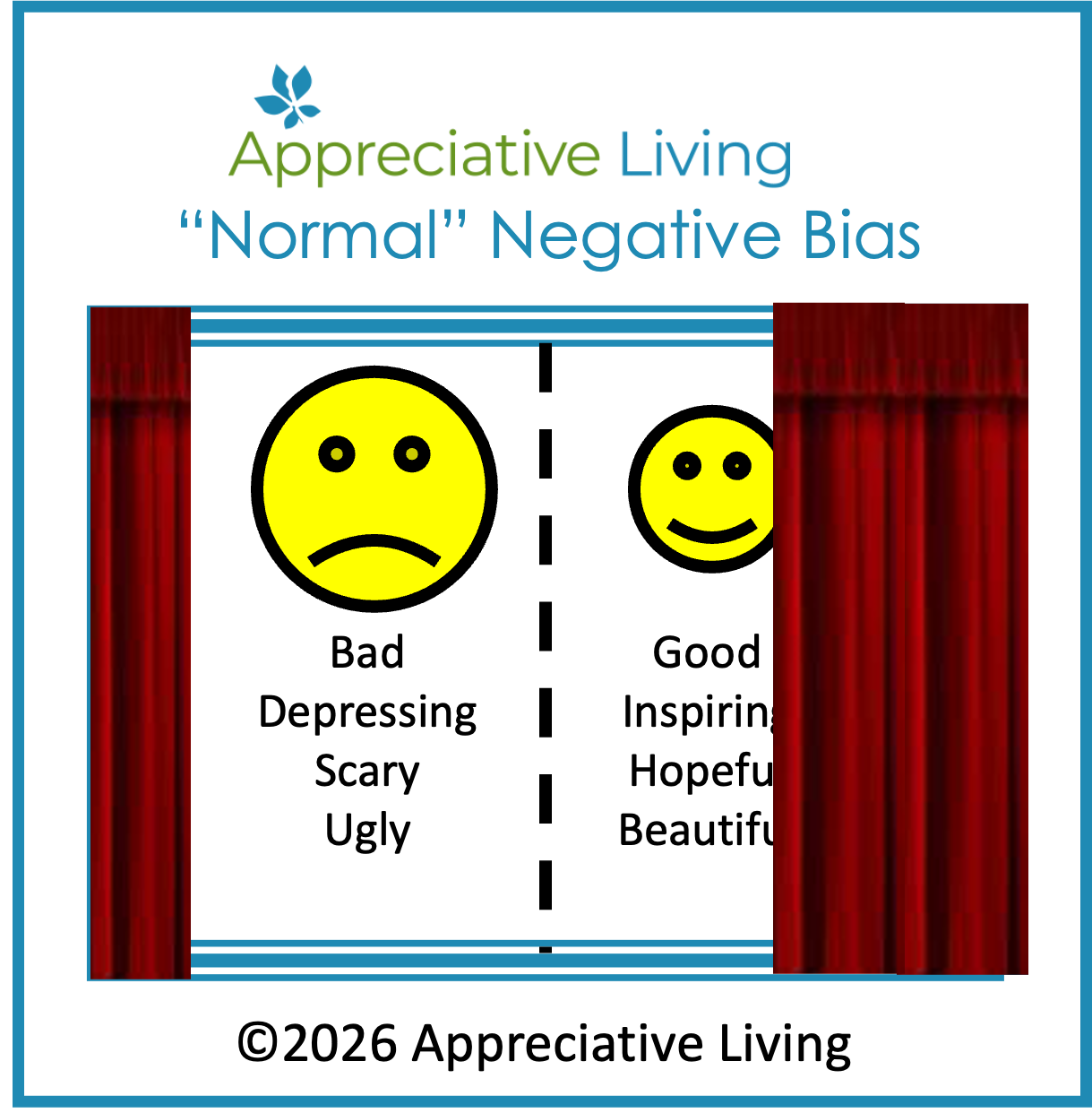
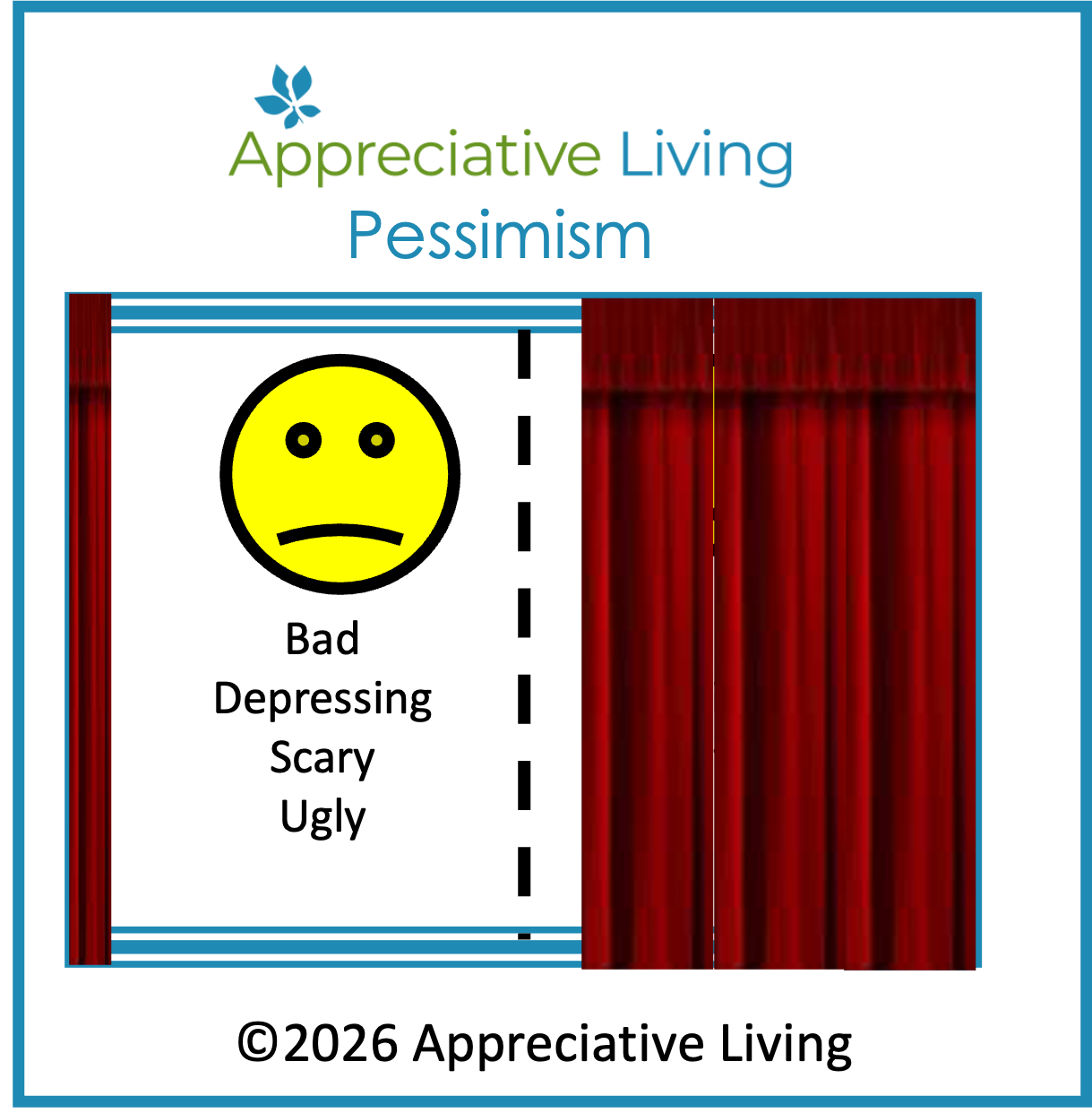

The brain has a natural negative bias as depicted in the top left graphic, which is like covering up part of the positive side of reality with a curtain. Next to it is a more extreme form of negative bias called pessimism, where most of the positive side is covered up and focus is highly negative.
The far right shows denial or rose-colored glasses, which is like covering up the bad stuff or pretending it doesn’t exist. People often mistake this perspective as the Appreciative Mindset but it’s definitely not.
The diagrams at the bottom depict the Appreciative Mindset and there are two levels. Level 1 is increasing positive focus to expand your perspective. This offsets your natural negative bias and creates a more balanced view of reality.
Level 2 of the Appreciative Mindset is transforming negatives into positives. It’s like moving the center line so the way you view and experience reality is genuinely more positive. This is not pretending things are better than they are or ignoring problems, it’s using the Appreciative Living tools and techniques to physically and emotionally change how you perceive and interact with the world.
The Appreciative Mindset essentially helps us refocus and reframe our view of good and bad to create a more positive perspective, which leads to a more joyful life.
How to Develop an Appreciative Mindset (The AIA Model)
The Appreciative Mindset is not a personality trait, it’s a learned skill. Some people and cultures have a natural predisposition to this framing, but most of us in the Western world do not.
There are a variety of practices for creating an Appreciative Mindset, but the core model is The Appreciative Living AIA 3-step Model. Each step has a core question as follows.
- APPRECIATE What Is: What’s good?
- IMAGINE the Ideal: What do I want?
- ACT in Alignment: What do I want to do?
The first step of asking “what’s good” directs focus to the positive side of the screen accomplishing two things. First, it makes you feel better, because focusing on positive aspects makes you feel good. You get more of what you focus on.
The second thing it does is create a more positive brain state, which improves cognitive function. The better you feel and less stressed you are, the better your brain works. It makes it easier for you to solve problems and come up with new ideas, and creates more energy and momentum to act on them.
The second step of asking “what do I want” is a powerful question that shapes your future. The brain moves in the direction of the future images it holds, and thinking about what you want is like plugging a visual destination into your brain’s GPS. It begins to call attention to related aspects in your environment and move you towards that direction.
The final step helps you align your behavior to what you want, and a key distinction with Appreciative Living is to notice what you feel inspired, excited or motivated to do. This drives action from inspiration rather than guilt or resistance which is not sustainable. A common question asked here is, what is one thing I could do, no matter how small, to move me in the direction of what I want?
These three questions taken together are the bedrock of the Appreciative Mindset. If you did nothing but ask them all day, every day, your life experience would likely transform beyond anything you can imagine. I say this after having seen it many times over the years.
Ready to Build an Appreciative Mindset in 7 days?
In just 10 minutes a day, you’ll learn how to build an Appreciative Mindset to feel happier, less stressed, and more in control of how you respond to life.
FAQs (Frequently Asked Questions)
1. How is the Appreciative Mindset different from gratitude practices?
Gratitude is generally a simple practice of listing what you are grateful for. The parallel practice in Appreciative Living is doing an Appreciation List which differs in two ways. The first is that the experience of appreciation is slightly deeper emotionally than gratitude. I can be grateful my car didn’t die, whereas I appreciate how dependable my car is. The difference is subtle. The second way the Appreciation List is different is that you take time to intentionally focus on what you appreciate and build positive emotion. The core objective of the exercise is to generate positive feelings and increase them as much as possible. Emotion helps accelerate the rewiring of the brain and speed up results.
2. Does the Appreciative Mindset ignore negative emotions or real problems?
Not at all. The Appreciative Mindset changes how negative emotions and problems are perceived, not whether they exist. Grief, sorrow, fear, and frustration are seen as normal human experiences rather than dysfunctions or moral failures. By shifting perspective and focus, these emotions often become less overwhelming and easier to work with, creating more capacity for insight, healing, and constructive action. There are also a core set of tools within Appreciative Living that work directly with negative habits and patterns, using them as catalysts for personal transformation.
3. How does the Appreciative Mindset change beliefs and behavior?
The Appreciative Mindset works upstream of behavior by changing what you focus on and the meaning you make. Over time, this shifts underlying beliefs about yourself, others, and what’s possible. As beliefs change, behavior follows naturally, with far less effort or willpower.
4. How long does it take to develop an Appreciative Mindset?
The time it takes to develop an Appreciative Mindset depends on several factors. First, how often you do the practices and for how long. The longer and more often the better. Second, how well you are able to generate positive emotion when you do the practices. The deeper and longer the positive feelings, the faster the brain will rewire.
5. Is the Appreciative Mindset a personality trait or something you’re born with?
No. The Appreciative Mindset is a learned pattern of thinking. While some people or cultures may lean toward it naturally, most people have been conditioned to focus on problems and threats. Appreciative Living offers simple practices and tools to intentionally cultivate this mindset regardless of background or personality style.


.