Habit BreakerTM from Appreciative Living
Stop or regain control over unwanted habits by changing the beliefs attached to them.
It’s been a long day. You’re tired, anxious, bored, worried, lonely, or overwhelmed. So you grab a cookie, drink, snack, phone, game console, vape, or TV remote. Or maybe you start worrying, overanalyzing things, or compulsively thinking about what could go wrong.
Next thing you know it’s two hours later and you did it again. You ate, drank, worried, played, scrolled, shopped, procrastinated, or obsessed more than you intended. You keep telling yourself you’re going to stop or cut back but you just can’t seem to do it.
But what if you could?
And what if stopping your compulsion did not require willpower, discipline, or even knowing your triggers?
I’m here to say I’ve done this successfully with the new Habit Breaker™ methodology I developed. And for some of the poeple I’ve worked with, it’s happened in a single session.
What is Habit BreakerTM ?
Habit Breaker™ is a standalone methodology for rapidly stopping or gaining control over unwanted Thought, Feeling, or Behavior Habits by changing the beliefs attached to them.
It provides baseline assessments, the Habit Breaker™ Unraveling Technique for breaking them, and the Rebuilding Framework for establishing new patterns after the habit is gone. It can be used on its own or within Step 2 of the Rapid Change Process, the broader change methodology at the heart of Appreciative Living.
Habit Breaker was developed by Jackie Kelm from more than 20 years of developing, teaching, and applying Appreciative Living.
When a Habit Fully Unravels, Urges Disappear
What are the most surprising things I’ve observed when the Habit Breaker™ Unraveling Technique works, is the person no longer has the old urges to do it. Instead they experience:
- No more cravings or urges to do the behavior.
- Increased sense of choice and presence
- Ability to stop it, control it, or do it in moderation
- Insights on the beliefs driving the habit
- Feeling neutral around former triggers
The most common and surprising report is this: “I just don’t want to do it anymore. I feel like I’m in control now rather than it controlling me.”
While this doesn’t happen with every habit, and some habits require more time or additional approaches, I’ve seen it happen in a single session.
What Habit Breaker is NOT
Habit Breaker is not hypnosis, therapy, or a “just stop doing it” approach. It does not depend primarily on willpower, discipline, or suppressing an urge.
Instead, it uses the Habit Breaker Unraveling Technique to identify and examine the beliefs keeping the unwanted habit in place. When the habit beliefs fully unravel, the urge connected to the habit disappears. This makes it possible to stop or regain control without continually fighting yourself.
The Three Habit Expressions: Thought, Feeling, Behavior
Habit Breaker uses a broader definition of a habit than we typically do. I define a habit as a learned, automatic, repeated pattern of thought, feeling, or behavior.
I use the term habit expressions for the three ways a habit can be expressed and experienced. Every habit has all three expressions, although one may be primary.
They are as follows.
Thought Habits
Automatic, repeated patterns of thinking such as overthinking, worrying, catastrophizing, negative self-talk, or constantly replaying scenarios in your mind.
Feeling Habits
Repeated emotional patterns that arise automatically, such as feeling anxious when alone, tense at certain times of day, or stressed every Sunday evening.
Behavor Habits
Repeated physical actions that feel automatic such as overeating, scrolling, procrastinating, gaming, or staying up late.
Habit Breaker can be used with all three Habit Expressions, but I’ve found that the Unraveling Technique appears to work most consistently with Behavior Habits. It has also worked with Thought and Feeling habits, but sometimes requires additional approaches.
The Two Types of Habits: Seeking and Avoiding
Habit Breaker also distinguishes between two types of habits based on what the habit is trying to accomplish.
1. Seeking Habits
Seeking Habits are habits you do to get a reward or good feeling. Examples include late-night snacking, scrolling, gaming, shopping, or repeatedly checking the news.
You feel pulled toward doing something because you anticipate some kind of benefit, pleasure, comfort, or relief.
2. Avoiding Habits
Avoiding habits are habits you do to escape or avoid discomfort. Examples include procrastinating, avoiding exercise, putting off difficult conversations, or not dealing with finances or household tasks.
In both cases, the habit makes sense based on what you currently believe it is doing for you. Habit Breaker begins by understanding those perceived benefits rather than fighting them.
The Two Habit Breaker Scales
There are two scales we use in the Habit Breaker methodology as part of the comprehensive Habit Baseline.
The first is the Habit Strength Scale, which is a subjective assessment designed to help identify the degree of control someone currently has over a habit. It is not a diagnostic or clinical tool.
The second is the Rebuild Effort Scale, which determines the effort that may be needed to establish new ways of thinking, feeling, and behaving after breaking a habit.
The two scales together help measure progress, and also help determine how difficult it will be to break a habit and sustain the change.
The Cortex Reptile Model: A Habit Breaker Metaphor
The brain is incredibly complex. When you struggle to change an unwanted habit, it’s because part of you believes you should do it and part of you believes you should not. To explain how this works more simply I created the Cortex Reptile Model with two characters called the Reptile and the Cortex.
The Cortex
The Cortexis represents conscious, analytical thinking that evaluates and critiques habits and beliefs. It’s analyzes, judges, makes decisions, and basically, well, thinks. It’s the voice that wants you to stop eating sugar and uses discipline to do it.
The Reptile
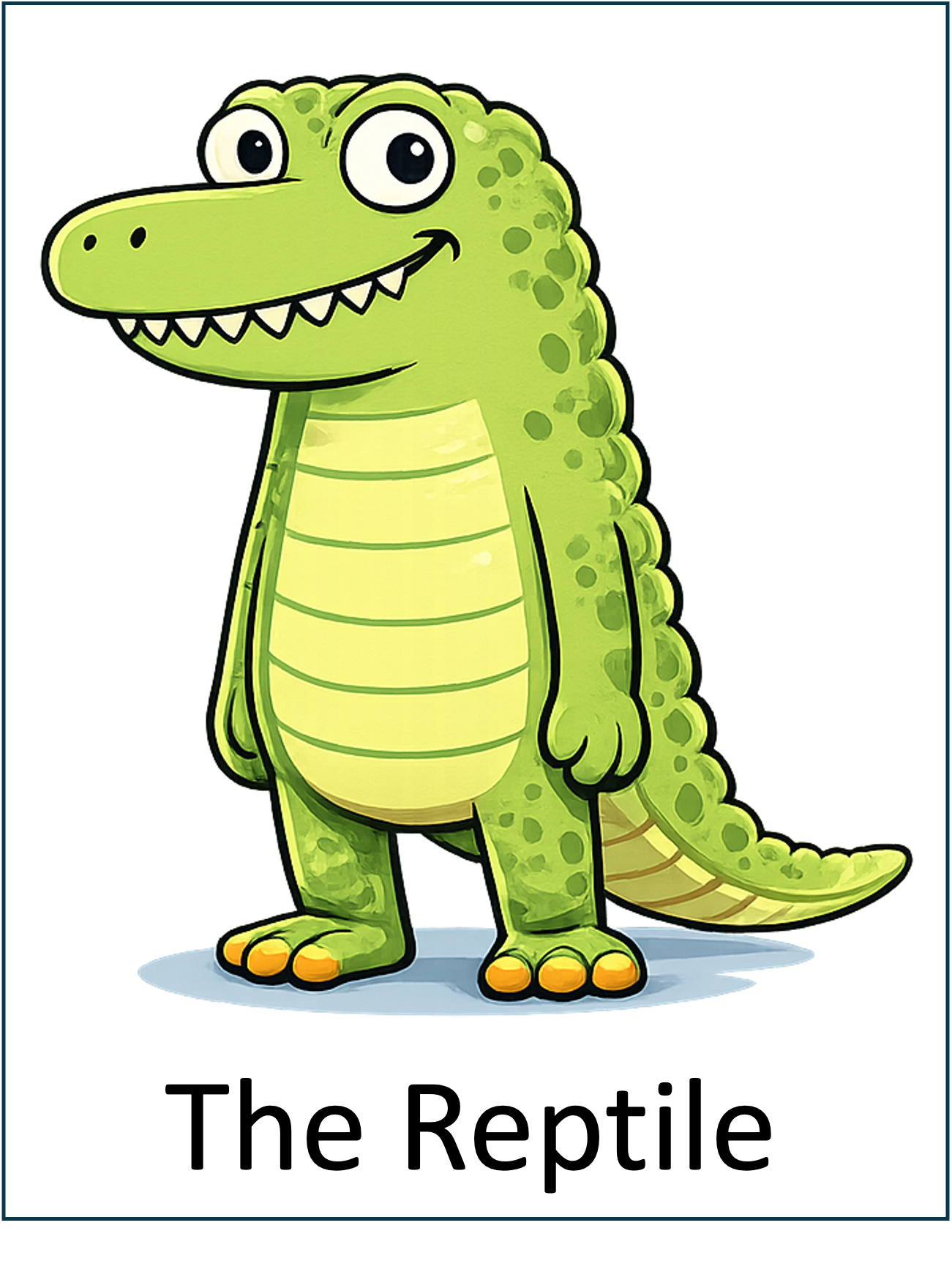
The Reptile represents the more auotmatic, feeling part of your mind that creates and maintains habits and beliefs. It’s the part that creates the urges that make you act on habits and compulsions because it believes the habit is serving you in some way. It might see it as providing comfort or pleasure, or helping you escape feeling lonely or anxious.
While both parts do important things, the Reptile runs the show. It tends to be stronger from an evolutionary standpoint, and the urges and emotional drives it creates can overpower discipline with time. The Habit Breaker Unraveling Technique explores the differing beliefs of each part, and helps them come to agreement on what’s truly serving you.

The Habit Breaker™ Unraveling Technique
At the center of Habit Breaker is the Habit Breaker Unraveling Technique, the three-step intervention for identifying and shifting the limiting beliefs keeping an unwanted habit in place. The three steps are:
1. Indulge the Reptile:
Explore the Reptile’s perspective on the unwanted habit.
2. Unravel the Reptile
Examine whether that perspective actually holds up.
3. Lock it In.
Reinforce the shift so the new understanding can take hold.
The process draws on Appreciative Inquiry and inversion thinking, bringing curiosity and appreciation to the habit while examining it from a different perspective. It essentially gets both brains to agree on whether the habit is truly serving you or not. If the Reptile agrees the habit is not serving you, it stops the urges to do it the moment that belief shifts.
What Are Habit Beliefs?
Habit beliefs our beliefs about how a particular habit serves you.
For example, someone who binges on sugar might hold a Habit Belief that eating sugar comforts them. Or they might believe it helps them feel less lonely.
Someone who worries repeatedly might have the Habit Belief that worrying helps them stay in control or helps keep them prepared for future crises.
There can also be deeper General and Core Beliefs underneath a habit that are not necessarily related to the habit itself. For example, you might have a Habit Belief that eating sugar comforts you, which is driven by a General Belief you are emotionally fragile.
The Unraveling Technique works directly with Habit Beliefs, which can be enough to stop the habit in some cases. In other cases where there are deeper General and Core beliefs involved, other approaches may need to be used alongside Habit Breaker. Within Appreciative Living, the Rapid Change Process can be used for this broader work.
How Long Does the Change Last? It Depends
Breaking a relatively weak habit that’s not playing an important role in your life may unravel quickly and that’s the end of it. This has happened with people I’ve worked with on things like afternoon snacking or occasional sugar binging where there did not appear to be much beneath the behavior aside from the physical desire.
Habits that are playing a more important role in your life or serving deeper beliefs are different. This might be something like compulsively escaping into screens for large periods of time to feel connected and fulfilled, or to avoid feeling lonely or depressed. Breaking the habit will leave you face-to-face with the unwelcome feelings you’ve been avoiding along with an empty block of time.
If those broader beliefs are not addressed the habit can come back over time, or a new habit can get created to replace it. Stopping the behavior in these situations is real progress but it isn’t always the whole story.
This is also the point where professional help may be required to deal with what comes up. And for true addictions or clinical conditions, Habit Breaker should be used with appropriate professional or medical support. It is designed to complement therapy, recovery programs, and other forms of clinical help, not replace them.
And for non-clinical conditions, I created the Rebuilding Framework to deal with what happens after breaking a habit.
The Rebuilding Framework: What Happens After Breaking a Habit
After an unwanted habit breaks, the brain may need time to adjust to life without the old pattern I call this the rebuilding framework and there are three phases.
1. Cortex Confusion
This is the phase right after stopping a habit when the Cortex can’t make sense of what is happening and creates confusing thoughts. It can include things like, “This isn’t real,” or” This will never last.”
2. Cortex Experimentation
This is the phase of habit rebuilding when the Cortex begins experimenting with what to do instead of the original habit. You might try a new activity, find a better habit, or deal with the new feelings or issues that may have surfaced.
3.New Normal
This is the final phase of habit rebuilding when new ways of thinking, feeling, or behaving become automatic and no longer require conscious thought. It’s essentially when you form new habits or ways of doing things that feel “natural” and don’t require your conscious attention.
Some habits do not require any rebuilding while others leave a large gap. The Rebuild Effort Scale helps estimate whether the rebuilding likely to follow will be Low, Moderate, or High.
What Kinds of Habits Can Habit Breaker™ Be Used With?
Habit Breaker has been used in my casework with a variety of unwanted habits including:
- Sugar binging and cravings
- Excessive gaming, streaming, doomscrolling, social media, and other phone and screen use.
- Overeating and lack of food control
- Procrastination
- News overwhelm and excessive worry about global events
- Money anxiety and fear of spending
- Staying up too late
- Worrying and overthinking
- Avoiding PT exercises, and other forms of self-care.
- People pleasing and dominating others
- Resisting good habits such exercising, organizing, or cleaning up.
How Habit Breaker Fits within Appreciative Living.
Appreciative Living
https://AppreciativeLiving.com/what-is-appreciative-living The umbrella philosophy and integrated framework for personal transformation focused on creating greater joy and well-being.
The Appreciative Mindset
https://AppreciativeLiving.com/appreciative-mindset The core thinking orientation of Appreciative Living, focused on what’s good and what’s wanted.
Rapid Change Process
https://AppreciativeLiving.com/rapid-change Appreciative Living’s four-step process for creating what’s wanted in any area of life.
Habit Breaker™
A focused methodology for unwanted habits that can be used independently or within step two of the Rapid Change Process..
Frequently Asked Questions
How fast does Habit Breaker™work?
Results vary. Some habits I’ve worked with have unraveled in a single session, while others have taken more time or benefited from additional support. Habit Breaker is still relatively new, and my observations come from casework rather than large scale controlled research.
Do I still need to take action after the habit stops?
What happens after the habit stops? It depends on the habit. Some habits stop and require very little additional effort while others leave a gap that needs to be filled. This may require new skills, routines, resources or support.
Habit Breaker Rebuilding Framework describes this process while the Rebuild Effort Scale helps estimate how much additional rebuilding may be needed. For habits with High rebuilding effort or broader issues that need attention, Habit Breaker can be complimented by coaching, therapy, recovery programs, other appropriate approaches, or the Appreciative Living Rapid Change Process.
Can Habit Breaker be used with addiction or other serious conditions?
Habit Breaker is not a substitute for medical care, therapy, addiction treatment, or other appropriate professional support. If stopping a substance or behavior could create withdrawal, medical risk, or other serious consequences, work with a qualified healthcare or treatment professional. Habit Breaker may complement appropriate professional care, but it should not replace it.
Does Habit Breaker work with Thought and Feeling Habits?
Habit Breaker can be used with Thought, Feeling, and Behavior habits, but the Unraveling Technique may not always be sufficient on its own. My experience so far suggests it works most directly and consistently with Behavior Habits. Thought Habits may involve broader beliefs that need additional attention, while Feeling Habits may benefit from other approaches, including physical or somatic interventions.
Ready to Go Further with Habit Breaker?
Habit Breaker™ Coaching
Get help with your own unwanted habit.
Work one-on-one with Jackie Kelm using Habit Breaker.
Habit Breaker™ Core Skills Training
Learn how to use Habit Breaker with others.
Explore habit breaker Core Skills Training for coaches and helping professionals.

Copyright 2026 Appreciative Living, LLC | Terms of Use | Privacy Policy